 Shipping over $50




You picked up a bottle with a colored sleeve and turned it over, looking for the word plastic. Nothing on the label says it.
But it bends like plastic. So what is it?
Silicone is not the plastic you are thinking of, and it is not a natural material either. Its backbone is silicon and oxygen, not the carbon chains that make polyethylene or PET. It is a synthetic rubber, made from sand.
Calling it plastic is wrong. Calling it natural is a stretch.
And for a water bottle there is a second question, which matters more than the label. What actually touches the water?
What is silicone made of?
It starts as quartz sand.
The sand is silica, and heating it with carbon strips the oxygen off and leaves silicon metal. That silicon is then reacted and built into long chains of alternating silicon and oxygen atoms. Those chains are siloxanes, and a rubbery mass of them is what we call silicone.
So the raw material is common and the process is industrial. Both things are true at once.
What comes out is an elastomer. It stays flexible in a cold car and in a hot dishwasher. It does not go brittle the way an old plastic lid does.
So is silicone a plastic or not?
It depends entirely on whose definition you use.
Under the everyday definition — a petroleum-based polymer, molded, carbon-chained — silicone is not a plastic. Under the widest chemical definition, a synthetic polymer, plenty of chemists would file it there.
That is why the answers online contradict each other. Nobody is lying. They are using different words.
What is not in dispute: silicone contains no BPA and no phthalates. Those are additives of certain plastics, not ingredients of silicone.
Also not in dispute: silicone does not biodegrade, and curbside recycling does not usually take it. It is a material you keep, not one you throw away well.
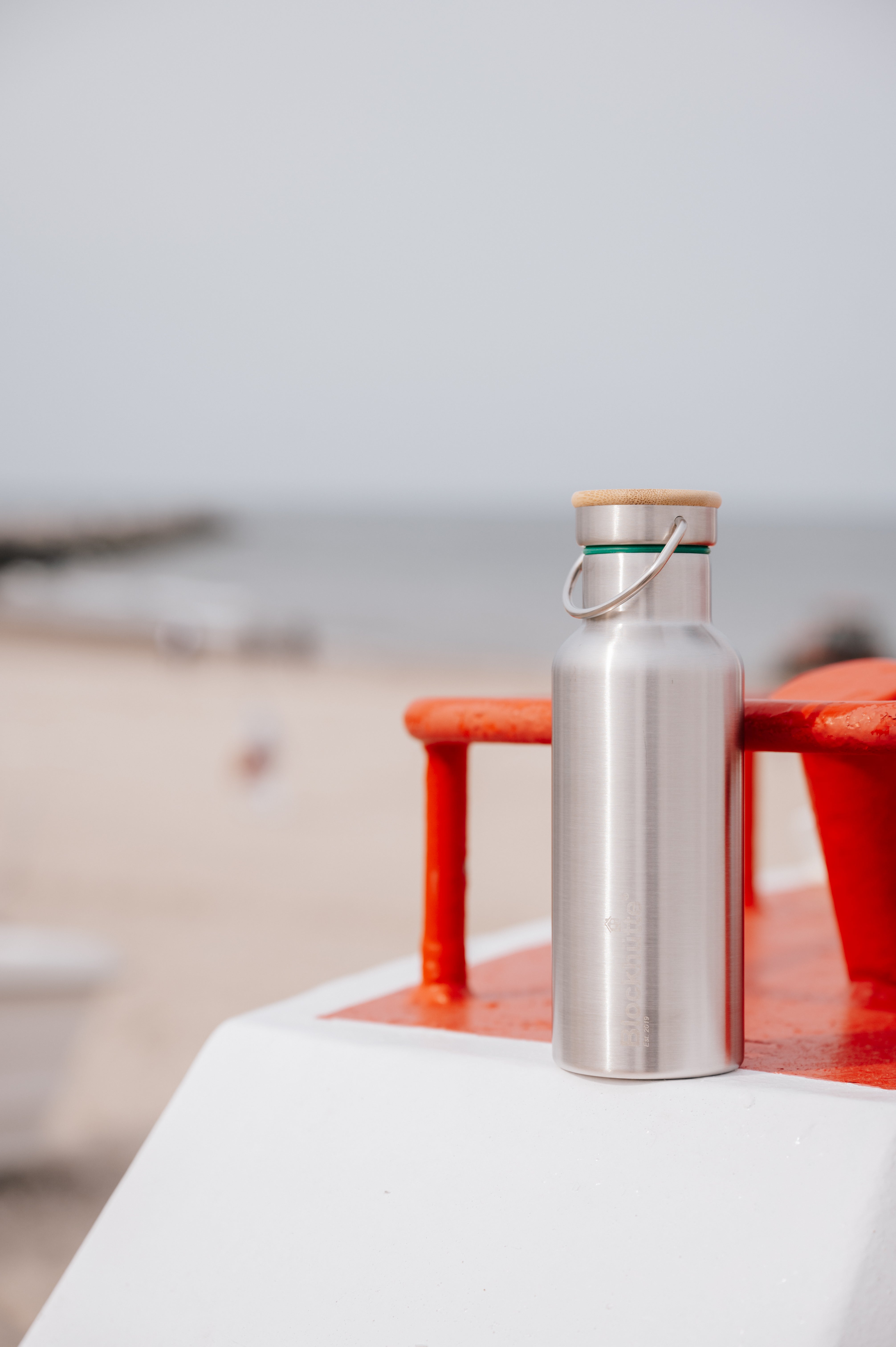
What actually touches your water?
On our bottles, steel. Only steel.
The insulated water bottle with a silicone coating is a steel bottle wearing a sleeve. The sleeve sits on the outside, around the lower half. Inside there is no coating and no liner. The wall your water sits against is uncoated 18/8 (304) stainless steel.
That is the whole point. The silicone does a job on the outside, where it never meets your drink.
The one place a soft material does sit in the path is the seal in the cap. That part has to be soft, or the bottle would not close.
Does silicone leach?
Research on food-grade silicone generally finds it stable.
Where migration does turn up in studies, it is with fatty food at high, sustained heat. Think frying temperatures, held for a long time. A bottle of cold water is not that situation, and neither is tea.
On our bottles the question is smaller still, because the sleeve is on the outside. The parts that do sit in the food path are the ones we test as food-contact parts.
Is the silicone on Blockhütte bottles tested?
Yes, and the reports are on the site, free, with no form and no account.
The silicone coating carries a REACH report: number 6277050.50QS, dated July 3, 2026. REACH is the European chemicals regulation. We use it for the silicone and metal parts that are not in food contact. The sleeve is exactly that.
The parts that do seal the bottle sit under a different report. That one is FDA 21 CFR 177.1210, dated July 22, 2026. It is the US rule for the parts that seal a food container.
Both are on our certificates page, next to the CPSIA lead reports for the same bottles. Every report was issued by DEKRA Testing and Certification in Shanghai.
Note the dates. The silicone report is from July 3, the rest are from July 22. Two different test runs, two different dates.

When is a silicone sleeve the better choice?
Three situations, and none of them are about safety.
Grip. Bare steel gets slippery with wet hands, and a full 34 oz bottle is heavy. A sleeve gives you something to hold.
“The silicone makes a big difference to my arthritic hands.”
Donna A., verified review
Protection. Steel dents. A sleeve takes the first drop for you, and it is the half of the bottle that hits the ground.
Quiet. A steel bottle set down on a desk announces itself. With a sleeve it does not, which matters in a meeting more than you would expect.
And there is a fourth, smaller reason. The sleeve comes in six colors, and in a room full of steel bottles that is how you find yours.
And when is bare steel better?
When you want the slimmest bottle in the bag.
A sleeve adds diameter, and a narrow bottle slides into a side pocket that a sleeved one does not. The plain vacuum insulated water bottle is the same steel. Same 25 hours cold, same 13 hours hot, no preheating.
It is also easier to wipe clean, because there is nothing for dust to sit in.
Both bottles are dishwasher safe, sleeve included.
Questions people ask
Is silicone the same as plastic?
No. Conventional plastics are built on carbon chains and made from petroleum. Silicone is built on silicon and oxygen, and it starts as quartz sand. It is a synthetic material either way, so “silicone-free” and “plastic-free” are not the same claim. Ours is a sleeve on the outside of a steel bottle.
Is silicone BPA-free?
Yes. BPA is an ingredient of some hard plastics and epoxy liners, not of silicone. The same goes for phthalates, which are softeners used in certain plastics. Silicone is already soft, so it needs none. Our bottles are also tested for phthalates under the US CPSIA.
Is a silicone sleeve safe for drinking water?
On our bottles the sleeve never touches the water. It sits on the outside of the steel, around the lower half. The drinking path is uncoated 18/8 steel and the seal in the cap. The sleeve carries its own REACH report, dated July 3, 2026, on our certificates page.
Can the silicone sleeve go in the dishwasher?
Yes. Every part of our bottles is dishwasher safe, including the sleeve, the cap and the seal. Take the seal out of the cap once a week so the groove dries fully. That is the one habit that keeps a seal working for years.
The short version
Silicone is not plastic, and it is not nature either. It is sand, turned into rubber.
On a bottle, the question that decides things is not the sleeve. It is what the water sits against, and here that is bare steel.
If you want to read the reports before you decide, they are all on the certificates page. No form, no account, just the PDFs.


